- 0m Duration
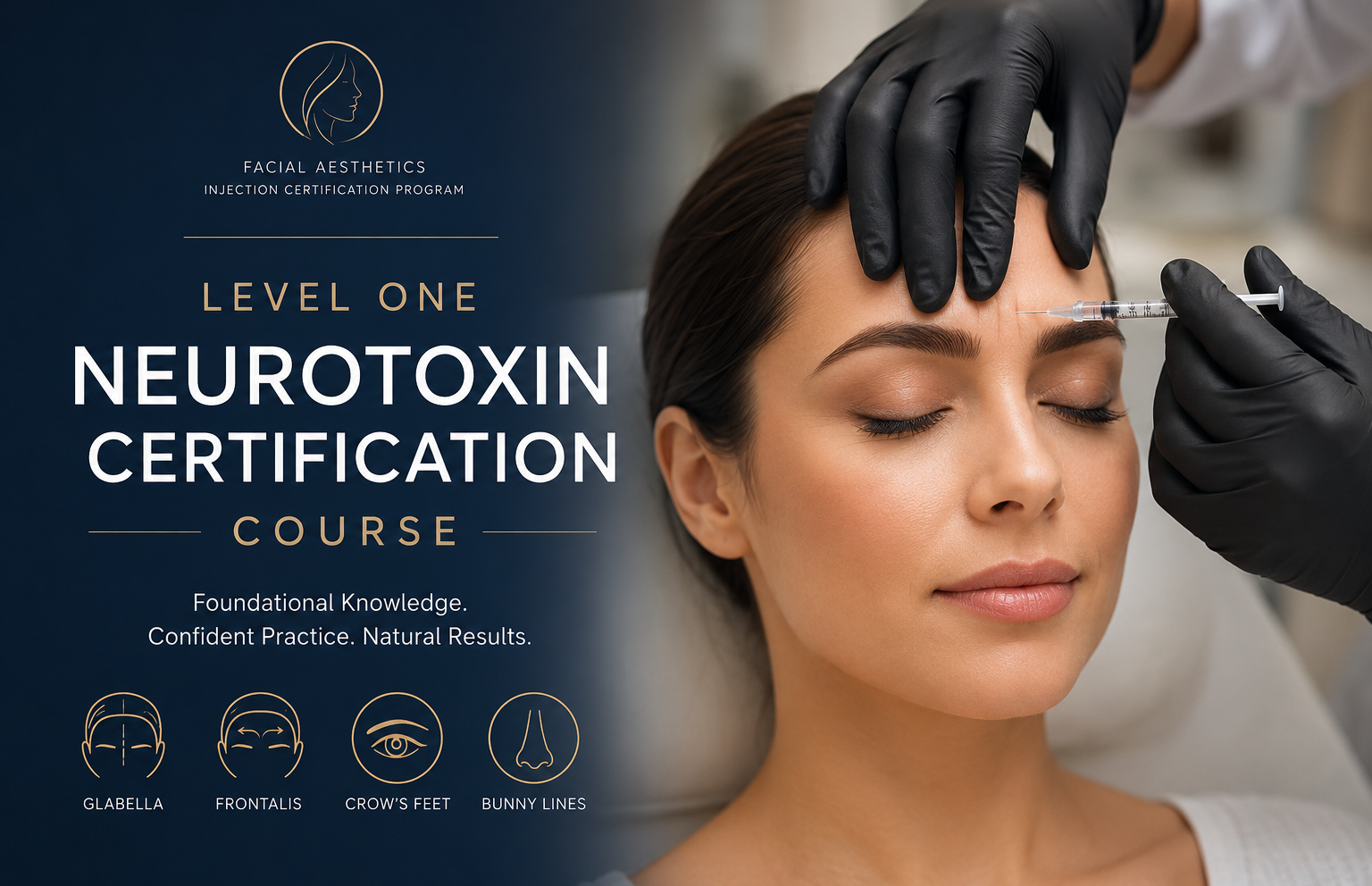
The Level One Neurotoxin Certification Course provides qualified healthcare professionals with foundational education and supervised practical training in the assessment, planning, and administration of botulinum toxin for common facial aesthetic indications.
The course combines online didactic education with instructor-supervised, hands-on clinical training. Emphasis is placed on facial anatomy, muscle function, patient assessment, appropriate treatment planning, injection safety, dosing principles, injection technique, documentation, informed consent, prevention of complications, and recognition and management of adverse events.
Level One concentrates on commonly treated upper-face areas:
- Glabellar complex
- Frontalis/forehead
- Lateral canthal lines (crow's feet)
- Nasalis/bunny lines
The course emphasizes conservative treatment planning, preservation of natural facial expression, patient safety, and individualized treatment based on anatomy rather than standardized injection patterns alone.
Want to submit a review? Login
This course includes
8-Hour Hybrid Certification Course – 4 hours online didactic education and 4 hours in-person clinical training.
Facial Anatomy & Muscle Function – Focused review of anatomy essential for safe neurotoxin injections.
Four Core Treatment Areas – Glabella, forehead/frontalis, crow’s feet, and bunny lines.
Patient Assessment & Consultation – Facial analysis, dynamic muscle assessment, symmetry evaluation, patient selection, and treatment planning.
Neurotoxin Fundamentals – Mechanism of action, product characteristics, handling, preparation, and treatment principles.
Injection Technique & Safety – Landmark identification, injection depth, placement principles, conservative dosing, and safe needle handling.
Live Clinical Demonstration – Step-by-step treatment demonstration performed by an experienced instructor.
Supervised Hands-On Training – Participants practice assessment, treatment planning, and injections on live models under direct supervision.
Complication Prevention & Management – Recognition, prevention, and appropriate response to ptosis, asymmetry, unwanted muscle weakness, bruising, and other potential adverse events.
Informed Consent & Documentation – Proper patient consent, clinical photography, treatment documentation, product tracking, and follow-up.
Post-Treatment Care – Patient education, expected outcomes, follow-up assessment, and management of treatment concerns.
Knowledge & Clinical Competency Evaluation – Written assessment and instructor-supervised clinical skills evaluation.
Certificate of Completion – Awarded to participants who successfully complete the didactic, clinical, and competency requirements.